
| Home > Fort Harrison | ||
|
|
Fort HarrisonA Fitting First Victory: It is poetic justice that the Richmond Battlefields Association's inaugural preservation success should come at Fort Harrison in 2002. In 1927, early Richmond preservationists—including Douglas Southall Freeman—began their mission "to acquire historic sites for preservation and restoration" by purchasing this same fort at public auction with borrowed funds. Seventy-five years later, the RBA took up that legacy to ensure this hallowed gound remained protected. Facilitated by a generous loan from the Civil War Preservation Trust, the RBA successsfully raised the necessary funds to secure the site. This historic property has since been incorporated into the Richmond National Battlefield Park, standing as a permanent testament to our mission.
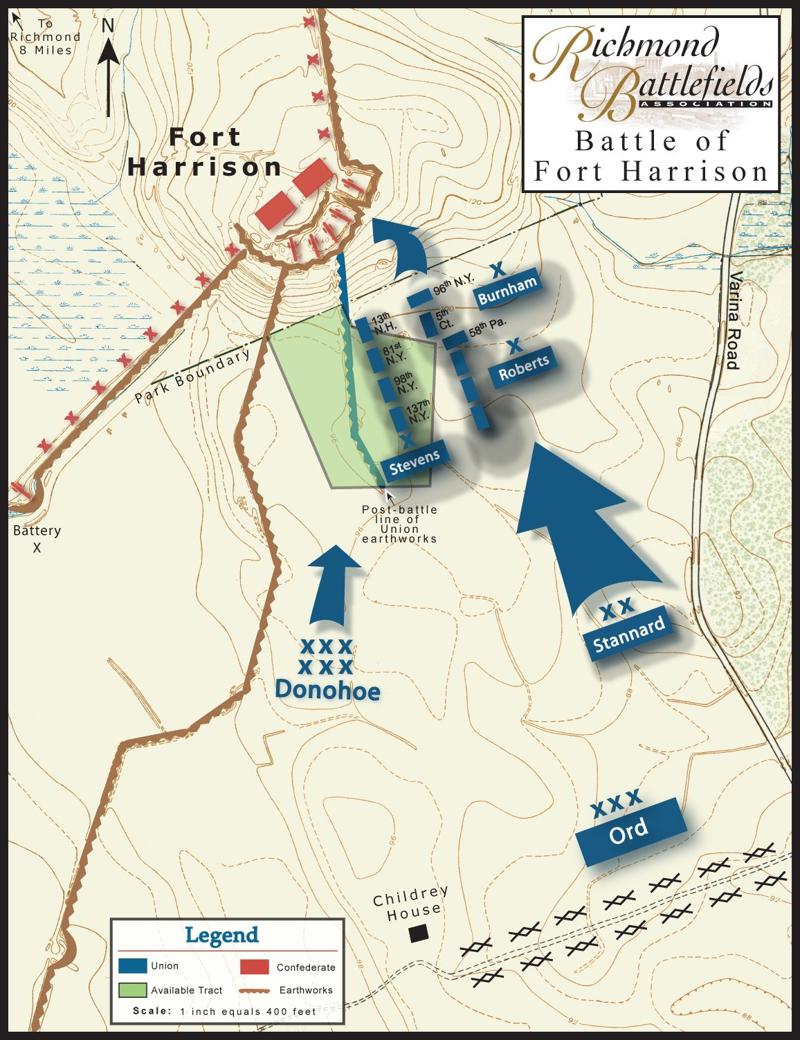
September 29, 1864Union XVIII Corps Assault: South of Richmond, several lines of earthen fortifications guarded the approaches to the Confederate capital. The largest and most formidable of these was Fort Harrison, located at Chaffin’s Farm. On the night of September 28–29, elements of Gen. Benjamin Butler’s Army of the James crossed the river to launch a dual offensive: the X Corps struck New Market Heights while the XVIII Corps stormed Fort Harrison and its satellite positions. Eight thousand soldiers from Gen. George Stannard’s division braved a flat, barren field under intense fire to reach the fort’s massive walls. In a desperate scramble, Union troops hoisted themselves up the steep embankments, some jamming bayonets into the earth to use as makeshift ladder rungs. After a brief but violent struggle atop the parapets, the Confederate defenders were overwhelmed, and Stannard’s survivors poured into the captured stronghold. September 30, 1864Lee's Counterattack: Recognizing the threat to Richmond, Robert E. Lee gathered reinforcements for a massive effort to reclaim the fort. Throughout the night, however, Federal troops had worked tirelessly to enclose the fort’s open northern face. Though the newly constructed wall was only a few feet high, it proved decisive. Lee’s counterattack faltered due to poor coordination; brigades attacked piecemeal at different intervals rather than in a unified wave. Each formation dissolved under withering Union fire, suffering heavy losses. Fort Harrison—renamed Fort Burnham in honor of a fallen Union brigade commander—remained in Federal hands for the rest of the war. The two days of fighting at Chaffin’s Farm resulted in nearly 5,000 combined casualties, marking it as one of the most significant actions of the Richmond-Petersburg Campaign. |

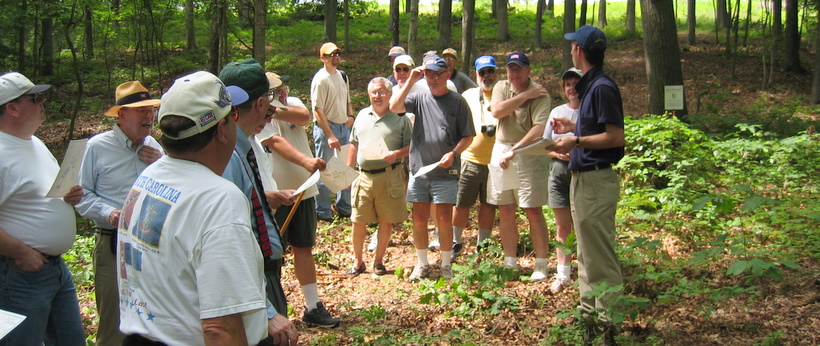
Above: At our annual meeting, RBA members tour the ground they helped save. Historian R.E.L. Krick describes the desperate struggle in front of Fort Harrison (June 2003).
Historian Richard J. Sommers discusses the September 1864 fighting at Fort Harrison (Jun 2003)
An important milestone: RBA Treasurer David West makes the final payment on the Fort Harrison property. |
| Top of Page | Previous Page | Home | ||

|
|
|

.jpg)
.jpg)