Glendale (Frayser's Farm)
A Vital Partnership: In 2006 and 2007, the Richmond Battlefields Association partnered with the Civil War Preservation Trust to secure critical tracts of the Glendale battlefield. The RBA dedicated $275,000 to the Glendale/Frayser's Farm preservation effort—a joint venture that served as the springboard for protecting virtually all the remaining core battlefield.
This achievement stands as a shining example of the effectiveness of a local, "on-the-ground" organization working in tandem with the resources of a prominent national group. It is a victory for the land, the history, and the community.
“We are engaged in a struggle to save America's Civil War legacy. Without the kind of commitment displayed by this year's recipients [RBA], many Civil War sites will be little more than a memory within a few years." - Jim Lighthizer, Civil War Trust
Battle of Glendale
June 30, 1862
In late June, Gen. George B. McClellan’s 100,000-man Army of the Potomac was in full retreat, stretched along the roads of eastern Henrico County as they sought the protection of Union gunboats on the James River. Gen. Robert E. Lee, newly appointed commander of the Army of Northern Virginia, devised an ambitious plan to intercept and destroy the Federal columns by converging his forces at the Glendale crossroads.
The execution, however, was fractured. Only the divisions of James Longstreet and A.P. Hill reached the objective, launching a ferocious assault up the Longbridge Road. What followed was some of the war's most prolonged and brutal hand-to-hand combat. Confederate forces successfully penetrated the Union line near Willis Church, routing McCall’s division and capturing the general himself.
The crisis was only averted by desperate Union counterattacks from Hooker’s and Kearny’s divisions, which sealed the breach and secured the Federal line of retreat along the Willis Church Road. This intense engagement left 7,000 men killed, wounded, or captured. Many historians consider Glendale as Lee’s best opportunity—perhaps of the entire war—to decisively destroy the Union army. Instead, the Federals continued south, reaching the safety of the James and preparing for the final stand at Malvern Hill.
.jpg)
An Exceptional Victory for Battlefield Preservation
Only a few short years ago, despite its immense historical significance, the Glendale battlefield remained highly vulnerable to development. Through a national effort spearheaded by the Richmond Battlefields Association and championed by the Civil War Trust, the core of this landscape has been saved from destruction.
“Never before in modern times has anyone preserved a major battlefield virtually from scratch." - R.E.L. Krick, Historian (retired), Richmond National Battlefield Park
This unprecedented achievement, combined with recent successes at Malvern Hill, ensures that future generations will be able to explore the "crown jewel" of the Richmond National Battlefield Park.
|

*RBA in concert with CWPT
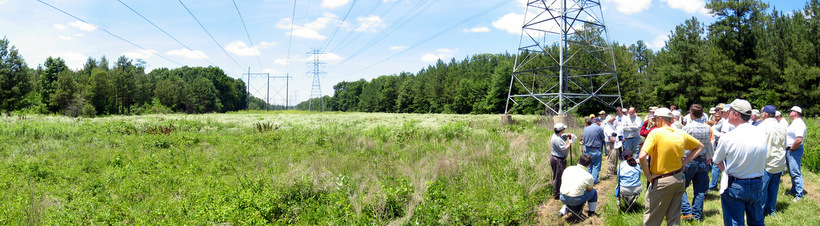
Above: RBA members tour the Glendale battlefield at our annual meeting (Jun 2004).
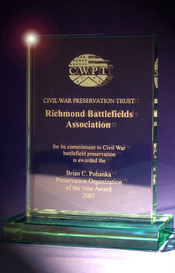
RBA was named "Preservation Organization of the Year" in 2007 by CWPT for its leadership role in preserving the Glendale Battlefield.
.jpg)
Historian William J. Miller leads RBA members on a tour of the Glendale battlefield.
.jpg)
RBA members visit the Whitlock Farm at Glendale, scene of the heaviest fighting.
.jpg)
In 2010 a Civil War Trails marker was erected on the Glendale battlefield to commemorate the charge of the 69th Pa. Inf. at the Whitlock farm.
.jpg)
|



.jpg)